The qSOFA score (quick Sequential Organ Failure Assessment) is a fast, three-point bedside check that helps clinicians flag adults with a suspected infection who are at higher risk of a poor outcome. Use the calculator on this page to work out a qSOFA score in seconds, then read on to understand the criteria, what a score of 2 or more means, and how qSOFA compares with SIRS and the full SOFA score.
qSOFA Score Calculator
Quick Sequential Organ Failure Assessment · bedside sepsis-risk screen (Sepsis-3)
Bedside observations
Enter measured values — each criterion is scored automatically. Or use “mark as met” if you only have the assessment.
Result
- Respiratory rate ≥ 22/min
- Altered mentation (GCS < 15)
- Systolic BP ≤ 100 mmHg
Independent check: 0 of 3 criteria met → score 0.
How the qSOFA score is read
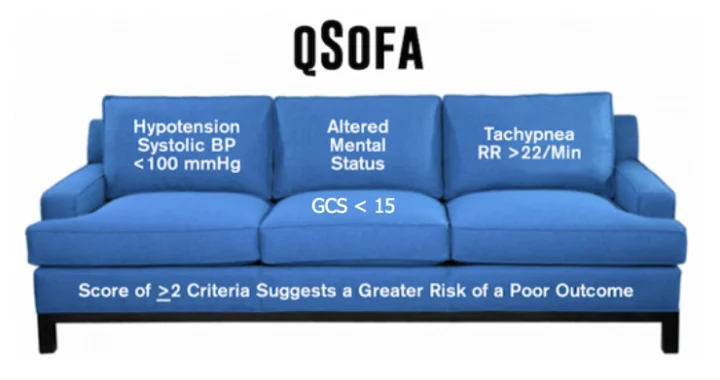
One point each for respiratory rate ≥ 22/min, altered mentation (any Glasgow Coma Scale value below 15), and systolic blood pressure ≤ 100 mmHg. The total ranges from 0 to 3.
| Score | Interpretation |
|---|---|
| 0–1 | Not positive by qSOFA. Lower probability of a poor outcome on this tool — but sepsis is not excluded. |
| 2–3 | Positive qSOFA. Associated with higher risk of in-hospital death or ICU stay of 3+ days in suspected infection. Prompts fuller assessment per local protocol. |
In the original derivation, patients with qSOFA ≥ 2 made up a minority of infected patients yet accounted for the majority of poor outcomes — high specificity, limited sensitivity. This is decision support, not a clinical recommendation; verify management against current guidance.
Three tools, three jobs
| Feature | SIRS | qSOFA | SOFA (full) |
|---|---|---|---|
| Measures | Systemic inflammation | Risk of poor outcome | Organ dysfunction |
| Items | 4 (temp, HR, RR, WBC) | 3 (RR, mentation, SBP) | 6 organ systems |
| Labs needed | Yes (WBC) | No | Yes |
| Positive | ≥ 2 of 4 | ≥ 2 of 3 | Acute rise ≥ 2 = dysfunction |
| Best setting | Infection screening | Rapid bedside flag outside ICU | ICU severity & Sepsis-3 definition |
Current Surviving Sepsis Campaign guidance recommends against qSOFA as a single screening tool, favouring SIRS, NEWS/NEWS2 or MEWS because of qSOFA's limited sensitivity.
Interpret with context
ICU patients: qSOFA was not designed for the ICU — use the full SOFA score for patients already critically ill.
Chronic hypertension: a systolic of 100 mmHg may represent significant relative hypotension against a high baseline; qSOFA uses an absolute cut-off, so read it alongside the patient's usual pressure.
Baseline dementia or encephalopathy: altered mentation is hard to score against a poor baseline — collateral history and the patient's usual state are essential.
Post-operative / sedated / anaesthesia: pain, medication and sedation can alter respiratory rate and mental status independently of infection.
A score below 2 does not rule out sepsis. Escalate any deteriorating patient regardless of the number.
Sources
- Singer M, et al. The Third International Consensus Definitions for Sepsis and Septic Shock (Sepsis-3). JAMA. 2016;315(8):801–810. Full text (PMC)
- Evans L, et al. Surviving Sepsis Campaign: International Guidelines for Management of Sepsis and Septic Shock 2021. Full text (PMC)
- Society of Critical Care Medicine — Surviving Sepsis Campaign adult guidelines
- CDC — About Sepsis
Last reviewed: July 2026 · Published by Clinical Tools Library
Full disclaimer & how to report an error
This calculator is provided by Clinical Tools Library as an educational reference and clinical decision aid. It does not provide a diagnosis, does not constitute medical advice, and must not replace clinical judgement or local protocols. All results depend on the values entered by the user. Reference thresholds reflect the Sepsis-3 (2016) definitions and were checked against the sources listed above; always verify figures against current labelling and guidance. Report suspected errors in this tool to Clinical Tools Library. For a suspected clinical adverse event, follow your national reporting route (for example, FDA MedWatch in the US, the MHRA Yellow Card scheme in the UK, or your local equivalent).
Last reviewed: July 2026

What is the qSOFA score?
The qSOFA score is a simplified, laboratory-free version of the Sequential Organ Failure Assessment. It was introduced with the Third International Consensus Definitions for Sepsis and Septic Shock (Sepsis-3), published in JAMA in 2016. Its purpose is narrow but useful: outside the intensive care unit, quickly identify adults with suspected infection who are more likely to deteriorate, need prolonged ICU care, or die in hospital.
Because qSOFA needs no blood tests and can be repeated at the bedside in under a minute, it works well in emergency departments, general wards and pre-hospital settings. It is a risk prompt, not a diagnosis of sepsis on its own.
qSOFA score criteria and components
There are three qSOFA criteria, each scoring one point, for a total range of 0 to 3. The components were selected as the bedside variables most strongly associated with poor outcomes in suspected infection.
| Criterion | Threshold | Points |
|---|---|---|
| Respiratory rate | ≥ 22 breaths/min | 1 |
| Altered mentation | Glasgow Coma Scale < 15 (any new confusion) | 1 |
| Systolic blood pressure | ≤ 100 mmHg | 1 |
| Total | Sum of criteria met | 0–3 |
How to calculate and interpret a qSOFA score
Add one point for each criterion the patient meets. A total of 2 or more is considered a positive qSOFA and marks a substantially higher risk of in-hospital death or a prolonged ICU stay. A score below 2 lowers that probability but does not exclude sepsis — clinical judgement always comes first, and a deteriorating patient should be escalated regardless of the number.
| Score | General interpretation |
|---|---|
| 0–1 | Lower risk on this tool; keep reassessing if infection is suspected. |
| 2–3 | Positive qSOFA — higher risk. Prompt fuller assessment, blood cultures, lactate, and senior review. |
qSOFA and sepsis: what a positive score means
A positive qSOFA in someone with suspected infection should trigger a structured response rather than a label. Typical next steps include measuring serum lactate, taking blood cultures before antibiotics where possible, calculating a full SOFA score, giving timely antibiotics per local protocol, and considering escalation of care. The U.S. Centers for Disease Control and Prevention stresses that sepsis is a medical emergency in which speed of recognition and treatment strongly influences survival.
Important limitation. The Surviving Sepsis Campaign recommends against using qSOFA as a single screening tool for sepsis, favouring SIRS, NEWS/NEWS2 or MEWS, because qSOFA is specific but relatively insensitive — it misses many patients who do have sepsis. Use it as one input alongside vital signs and clinical judgement, not as a rule-out test.
SIRS vs qSOFA vs SOFA
These three tools are often confused. SIRS looks for a systemic inflammatory response, qSOFA is a rapid risk flag, and the full SOFA score quantifies organ dysfunction and underpins the formal Sepsis-3 definition.
| Feature | SIRS | qSOFA | SOFA (full) |
|---|---|---|---|
| What it measures | Systemic inflammation | Risk of poor outcome in suspected infection | Degree of organ dysfunction |
| Number of items | 4 (temperature, heart rate, respiratory rate, white cell count) | 3 (respiratory rate, mentation, systolic BP) | 6 organ systems |
| Labs needed? | Yes (white cell count) | No | Yes (several) |
| Positive threshold | ≥ 2 of 4 | ≥ 2 of 3 | Acute rise ≥ 2 points = organ dysfunction |
| Best setting | Screening / infection recognition | Rapid bedside risk flag outside ICU | ICU severity & sepsis definition |
Related tools on Clinical Tools Library: the full SOFA score calculator, the SIRS criteria calculator, and the NEWS2 early warning score calculator.
Frequently asked questions
What is a qSOFA score?
A qSOFA score is a bedside sepsis-risk screen ranging from 0 to 3. One point is given for a respiratory rate of 22 or more, one for altered mentation (Glasgow Coma Scale under 15), and one for a systolic blood pressure of 100 mmHg or less. A score of 2 or more flags higher risk of a poor outcome in someone with suspected infection.
What is the difference between SOFA and qSOFA?
SOFA is the full Sequential Organ Failure Assessment, scoring six organ systems with laboratory values to measure organ dysfunction. qSOFA (“quick” SOFA) uses just three bedside signs and no blood tests, so it is faster but less detailed. SOFA defines organ dysfunction in Sepsis-3; qSOFA only flags who may need a closer look.
What qSOFA score indicates possible sepsis?
A qSOFA of 2 or 3 in a patient with suspected infection is considered positive and should prompt urgent further assessment. It does not confirm sepsis on its own, and a score of 0 or 1 does not rule sepsis out.
Is qSOFA still recommended for sepsis screening?
Current Surviving Sepsis Campaign guidance recommends against relying on qSOFA as the single screening tool, preferring SIRS, NEWS/NEWS2 or MEWS because qSOFA has limited sensitivity. qSOFA remains useful as one bedside indicator of severity alongside other tools.
What are the qSOFA criteria for sepsis?
The three qSOFA criteria are respiratory rate 22 breaths per minute or higher, altered mentation, and systolic blood pressure 100 mmHg or lower. Each is worth one point.
Educational reference only. This page and calculator are for general education and clinical reference, not medical advice, diagnosis or a prescription. Always follow your own clinician or local protocol, and independently confirm any figure before acting on it. qSOFA supports — but does not replace — clinical judgement. Sources include Sepsis-3 (JAMA 2016), the Surviving Sepsis Campaign guidelines and the CDC.