Converting a dose of semaglutide mg to units — or tirzepatide — is one of the most error-prone steps in using compounded GLP-1 medication, because an insulin syringe measures volume, not drug. The calculator above does the arithmetic for your exact vial; this guide explains how the semaglutide mg to units conversion works, gives dosage charts for the most common concentrations, and answers the questions clinicians and patients ask most.
Clinical conversion tool
GLP-1 dose converter: mg ↔ units
Convert a prescribed milligram dose of semaglutide, tirzepatide, liraglutide or retatrutide into the exact number of units to draw on an insulin syringe — for a given vial concentration.
Built for compounded multi-dose vials drawn with an insulin syringe. Brand-name pre-filled pens (Ozempic®, Wegovy®, Mounjaro®, Zepbound®, Saxenda®, Victoza®) dial a preset dose — use the device as labeled rather than drawing from it.
1 Delivery device
This converter is for vials drawn with an insulin syringe. Pens dose themselves.
2 Medication
3 Vial concentration *
4 Prescribed dose *
Enter the dose exactly as prescribed.
5 Insulin syringe
U-100 = 100 units/mL (most common). Using a U-40 syringe with a U-100 reading misdoses by 2.5×.
✓ What to draw
Enter a concentration and a prescribed dose to see the exact number of units to draw.
1 Delivery device
Check what a number of units actually delivers from a vial.
2 Medication
3 Vial concentration *
4 Units on the syringe *
5 Insulin syringe
U-100 = 100 units/mL. A U-40 syringe reads differently — match it to your syringe.
✓ Dose delivered
Enter a number of units and the vial concentration to see the milligram dose it delivers.
Titration schedules
Semaglutide — Wegovy® (weight management, once weekly)
Step up at intervals of ≥4 weeks. 0.25 mg is a non-therapeutic initiation dose. The 7.2 mg high-dose step is only used after at least 4 weeks at 2.4 mg.
Semaglutide — Ozempic® (type 2 diabetes, once weekly)
Tirzepatide — Mounjaro® / Zepbound® (once weekly, identical schedule)
2.5 mg is the initiation dose; increase in 2.5 mg steps at ≥4-week intervals. Maintenance doses are 5, 10 or 15 mg.
Liraglutide — Saxenda® once daily
Increase weekly. Victoza® (type 2 diabetes) uses 0.6 → 1.2 → 1.8 mg once daily. Unlike the others on this page, liraglutide is dosed every day.
Retatrutide investigational
Doses studied in the Phase 3 TRIUMPH program (TRIUMPH-1 reported May 2026). Retatrutide is not approved by the FDA or EMA and cannot be legally prescribed or compounded; no standard concentration exists.
Reference data reviewed: June 2026 · always verify against current labeling.
The conversion math
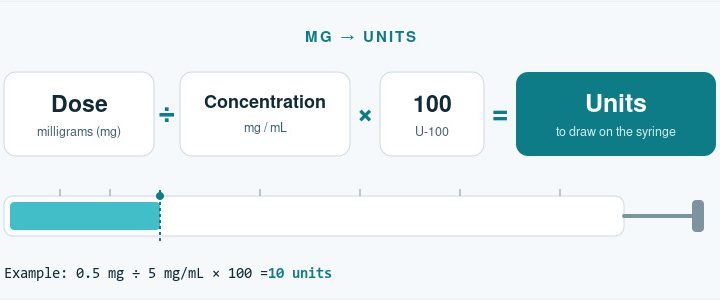
Volume (mL) = dose (mg) ÷ concentration (mg/mL)
Units = volume (mL) × units per mL — 100 for a U-100 syringe, 40 for U-40
Reverse: dose (mg) = (units ÷ units per mL) × concentration (mg/mL)
Worked example. A 0.5 mg dose from a 5 mg/mL vial = 0.5 ÷ 5 = 0.1 mL. On a U-100 syringe, 0.1 mL × 100 = 10 units. From a 1 mg/mL vial the same 0.5 mg would be 0.5 mL = 50 units — five times as far up the barrel.
Common compounded concentrations
These are concentrations reported for compounded vials. They are not standardised and vary between pharmacies — the figure printed on your own vial always governs.
| Drug | Reported concentrations | Brand reference |
|---|---|---|
| Semaglutide | 1 · 2.5 · 5 mg/mL | pens ≈ 1 mg/mL |
| Tirzepatide | 10 · 17 · 20 mg/mL | Zepbound® vials 4.17–25 mg/mL |
| Liraglutide | varies | pens 6 mg/mL |
Reference data reviewed: June 2026.
Regulatory status of compounded GLP-1s
Compounded semaglutide and tirzepatide are not FDA-approved products. The FDA shortages that allowed wide compounding were resolved in early 2025, and the temporary enforcement discretion for 503A and 503B compounding ended through 2025. In April 2026 the FDA proposed removing semaglutide, tirzepatide and liraglutide from the 503B bulk-substances list. This landscape is evolving and litigated; verify current status before relying on it.
Report suspected adverse events or dosing errors to FDA MedWatch.
FDA, “Alerts health care providers, compounders and patients of dosing errors associated with compounded injectable semaglutide products” (26 Jul 2024) · FDA, “Clarifies policies for compounders as national GLP-1 supply begins to stabilize” · FDA proposal to remove semaglutide/tirzepatide/liraglutide from the 503B bulks list (Federal Register, Apr 2026) · Wegovy®, Ozempic®, Mounjaro®, Zepbound®, Saxenda® and Victoza® Full Prescribing Information (FDA / DailyMed, 2025–2026) · University of Illinois Chicago Drug Information Group, safety review of compounded GLP-1 receptor agonists (2025) · Eli Lilly TRIUMPH Phase 3 results (TRIUMPH-4, Dec 2025; TRIUMPH-1, May 2026). Confirm against the current label and FDA guidance, which supersede this summary.
Reference data reviewed: June 2026.
What to do if you think the dose was wrong
If you suspect you drew or injected the wrong amount — for example, far more units than usual — act early rather than waiting to see how you feel.
Seek urgent medical help if you notice
- Persistent or severe vomiting, inability to keep fluids down, or signs of dehydration
- Severe or ongoing abdominal pain (a possible sign of pancreatitis), especially radiating to the back
- Fainting, dizziness, confusion, or symptoms of low blood sugar (sweating, shakiness, palpitations), particularly if you also take insulin or a sulfonylurea
- Any symptom that is severe, rapidly worsening, or frightening
What to do
- Contact your prescriber, the dispensing pharmacy, or a poison-control / emergency service for advice specific to your situation and country.
- Have the vial concentration, the dose, and the units you drew ready to tell them — the same three numbers this tool uses.
- Do not take more medication to “correct” a suspected error unless a clinician tells you to.
- Report dosing errors and adverse events to FDA MedWatch (or your national pharmacovigilance body).
This is general information, not a substitute for professional medical advice. If you or someone else may be seriously unwell, contact emergency services.
Not medical advice. This calculator is an educational reference for converting between units of measurement. It does not recommend a dose, endorse any product, or replace the judgement of a qualified prescriber and pharmacist.
Read the full disclaimer & sources
Purpose & limits
This tool performs arithmetic on values you enter. Its output is only as accurate as the concentration, dose and syringe type provided. It is intended for use by, or under the direction of, qualified healthcare professionals, and as a checking aid — not as authorisation to self-treat or to set a dose.
Concentration is decisive
The number of units depends entirely on the vial concentration. Applying a table or habit from one concentration to a different vial is the documented cause of 5–20× overdoses. Always read the concentration printed on the specific vial in hand and confirm your syringe calibration (U-100 vs U-40).
Compounded products
Compounded semaglutide, tirzepatide and liraglutide are not FDA-approved and their concentrations are not standardised. The regulatory position changed through 2025–2026 and continues to evolve; verify current FDA guidance and applicable law.
Retatrutide
Retatrutide is investigational and not approved by the FDA or EMA. It cannot be legally prescribed, sold or compounded for human use. Any values shown are for research context only.
No warranty
Provided “as is”, without warranty of any kind. The authors accept no liability for any loss or harm arising from its use. When in doubt, do not inject — contact the prescriber or pharmacy. Report adverse events to FDA MedWatch.
Primary sources: FDA dosing-error alert on compounded injectable semaglutide (Jul 2024); FDA compounding-policy updates and the 503B bulks-list proposal (2025–2026); Wegovy®, Ozempic®, Mounjaro®, Zepbound®, Saxenda® and Victoza® prescribing information (FDA / DailyMed); UIC Drug Information Group safety review (2025); Eli Lilly TRIUMPH Phase 3 results (2025–2026).
Always confirm the vial’s printed concentration and your syringe calibration before drawing. When in doubt, do not inject — contact the dispensing pharmacy or prescriber.

How to convert a GLP-1 dose from mg to units
An insulin syringe is graduated in units of volume. On the standard U-100 syringe, 100 units equals 1 mL, so 1 unit equals 0.01 mL. Because your dose is prescribed in milligrams but drawn in units, you need the vial’s concentration (in mg/mL) to bridge the two. The conversion is two short steps:
Units = volume (mL) × units per mL (U-100 → ×100, U-40 → ×40)
For example, a 0.5 mg dose drawn from a 5 mg/mL vial is 0.5 ÷ 5 = 0.1 mL, and on a U-100 syringe 0.1 mL × 100 = 10 units. The same 0.5 mg from a 1 mg/mL vial would be 50 units — five times further up the barrel. That single fact is why reading the wrong concentration has caused documented overdoses, and why getting the semaglutide mg to units conversion right starts with confirming the concentration on your vial before the calculator shows a result.
Semaglutide mg to units chart (compounded vials)
Working out the semaglutide mg to units conversion depends entirely on the strength of your vial. Compounded semaglutide is most often supplied at 1, 2.5 or 5 mg/mL, though concentrations are not standardised and vary between pharmacies. The tables below show how many units each labelled dose works out to on a U-100 insulin syringe. Brand-name semaglutide (Ozempic®, Wegovy®) is formulated near 1 mg/mL, which is a frequent source of confusion when a more concentrated compounded vial is dosed off a 1 mg/mL habit.
| Dose (mg) | At 1 mg/mL | At 2.5 mg/mL | At 5 mg/mL |
|---|---|---|---|
| 0.25 mg | 25 units | 10 units | 5 units |
| 0.5 mg | 50 units | 20 units | 10 units |
| 1.0 mg | 100 units | 40 units | 20 units |
| 1.7 mg | 170 units* | 68 units | 34 units |
| 2.4 mg | 240 units* | 96 units | 48 units |
*Exceeds a standard 1 mL (100-unit) insulin syringe. Higher semaglutide doses are normally drawn from a more concentrated vial; if your maths lands above 100 units, re-check the concentration with your pharmacy. The 0.25 mg step is a non-therapeutic initiation dose; the Wegovy® ladder is 0.25 → 0.5 → 1.0 → 1.7 → 2.4 mg (a 7.2 mg high-dose step was added in 2026), and Ozempic® tops out at 2.0 mg.
Tirzepatide mg-to-units chart (compounded vials)
Compounded tirzepatide is commonly reported at 10, 17 or 20 mg/mL. Tirzepatide (Mounjaro®, Zepbound®) follows a 2.5 → 5 → 7.5 → 10 → 12.5 → 15 mg ladder, increasing in 2.5 mg steps no sooner than every four weeks, with a 15 mg maximum. Units on a U-100 syringe:
| Dose (mg) | At 10 mg/mL | At 17 mg/mL | At 20 mg/mL |
|---|---|---|---|
| 2.5 mg | 25 units | 14.7 units | 12.5 units |
| 5 mg | 50 units | 29.4 units | 25 units |
| 7.5 mg | 75 units | 44.1 units | 37.5 units |
| 10 mg | 100 units | 58.8 units | 50 units |
| 12.5 mg | 125 units* | 73.5 units | 62.5 units |
| 15 mg | 150 units* | 88.2 units | 75 units |
*Exceeds a 1 mL (100-unit) syringe at 10 mg/mL — higher tirzepatide doses are usually supplied at 17–20 mg/mL. Values that are not whole units (e.g. 29.4) cannot be drawn exactly on a 1-unit-graduated syringe; confirm rounding with your pharmacy or prescriber.
Converting units back to mg
To check what a number of units actually delivers — useful if you want to verify a dose you have already drawn — reverse the formula:
For instance, 10 units on a U-100 syringe from a 5 mg/mL vial is (10 ÷ 100) × 5 = 0.5 mg. The calculator’s Units → Dose tab does this automatically and shows the volume in millilitres alongside it.
How to reconstitute semaglutide, tirzepatide and other peptides
Some compounded vials are supplied as a freeze-dried powder that is reconstituted with a diluent (usually bacteriostatic water) before use. Reconstitution does not change how much drug is in the vial — it sets the concentration, and therefore the number of units you draw. The resulting concentration is simply:
So a 5 mg vial reconstituted with 1 mL of bacteriostatic water becomes 5 mg/mL; a 10 mg vial with 2 mL becomes 5 mg/mL; and the same 10 mg vial with 1 mL becomes 10 mg/mL. The volume of water you add is what determines the concentration, and a different volume changes every unit figure in the charts above. The calculator’s Reconstitute from powder option works this out for you when you enter the total milligrams and the diluent volume.
Insulin syringe units and millilitres explained
Because “units” trip up so many people, it helps to separate two ideas. A unit on an insulin syringe is a measure of volume, fixed by the syringe’s calibration, while the dose is a measure of drug. They only line up once you apply the concentration.
- U-100 (standard): 100 units = 1 mL, so 1 unit = 0.01 mL. Almost all human insulin syringes are U-100.
- U-40: 40 units = 1 mL. Uncommon and mainly veterinary — using a U-40 syringe while reading a U-100 figure misdoses by 2.5×.
- Syringe sizes: 0.3 mL holds 30 units, 0.5 mL holds 50 units, 1 mL holds 100 units. Pick a size that comfortably holds your dose.
A few common conversions: on a U-100 syringe, 0.5 mL = 50 units, 0.25 mL = 25 units, and 0.1 mL = 10 units. To draw from a multi-dose vial, clean the stopper, draw the calculated number of units of air into the syringe, inject it into the vial, then withdraw to the exact unit mark on the barrel and expel any air bubbles before injecting as directed.
Brand pens vs compounded vials: don’t convert pens to units
Searches like “Ozempic mg to units”, “Zepbound mg to units” or “Mounjaro units” usually come from people holding a pre-filled pen. Pens are different from vials: they deliver a fixed, pre-set dose when you turn the dial and inject, and they are not measured in syringe units. You should never draw the contents of a pre-filled pen into an insulin syringe, and there is no “units” figure to calculate for a pen.
If you use a pen (Ozempic®, Wegovy®, Mounjaro®, Zepbound®, Saxenda® or Victoza®), set the prescribed dose on the dial and inject as instructed. The mg-to-units conversion on this page applies only to vials drawn with an insulin syringe — which is why the calculator stops and warns you if you select a pen.
Retatrutide dosage: what’s actually known
Retatrutide (LY3437943) is an investigational once-weekly triple agonist (GIP/GLP-1/glucagon). As of mid-2026 it is not approved by the FDA or EMA, cannot be legally prescribed, sold or compounded, and has no established maintenance dose or standard concentration. The doses studied in the Phase 3 TRIUMPH programme are 4, 9 and 12 mg once weekly. Any product marketed as “retatrutide” is not an approved medicine, and because no labelled concentration exists, a milligram-to-units conversion cannot be reliable. We include retatrutide in the calculator for research context only, clearly flagged as investigational.
Frequently asked questions
How many units is 0.25 mg of semaglutide?
It depends on the vial’s concentration. On a U-100 insulin syringe, 0.25 mg is 25 units from a 1 mg/mL vial, 10 units from 2.5 mg/mL, and 5 units from 5 mg/mL. Always confirm the concentration printed on your vial.
How many units is 0.5 mg of semaglutide?
On a U-100 syringe, 0.5 mg is 50 units at 1 mg/mL, 20 units at 2.5 mg/mL, and 10 units at 5 mg/mL.
How many units is 5 mg of tirzepatide?
On a U-100 syringe, 5 mg of tirzepatide is 50 units from a 10 mg/mL vial, about 29 units from 17 mg/mL, and 25 units from 20 mg/mL.
How many units is 2.5 mg of tirzepatide?
On a U-100 syringe, 2.5 mg is 25 units at 10 mg/mL, about 15 units at 17 mg/mL, and 12.5 units at 20 mg/mL.
How many units are in 0.5 mL?
On a standard U-100 insulin syringe, 0.5 mL is 50 units (because 100 units = 1 mL). On an uncommon U-40 syringe, 0.5 mL is 20 units.
How do I convert semaglutide units back to mg?
Use: mg = (units ÷ 100) × concentration, for a U-100 syringe. For example, 10 units from a 5 mg/mL vial delivers (10 ÷ 100) × 5 = 0.5 mg.
How do you reconstitute semaglutide, and how much bacteriostatic water do you add?
The resulting concentration equals the total milligrams in the vial divided by the millilitres of diluent added. For example, a 5 mg vial reconstituted with 1 mL of bacteriostatic water gives 5 mg/mL. Use the diluent volume specified by your pharmacy or product labelling — a different volume changes the concentration and the units you draw.
Can I draw an Ozempic, Wegovy or Mounjaro pen into a syringe?
No. Pre-filled pens deliver a fixed dose set on the dial and are not measured in syringe units. Pen contents should not be drawn into an insulin syringe. Set the prescribed dose on the pen and inject as instructed.
What is the dosage of retatrutide?
Retatrutide is investigational and not approved by the FDA or EMA, so there is no approved dose. Phase 3 TRIUMPH trials studied 4, 9 and 12 mg once weekly, and there is no standard concentration for a units conversion.
Why does the same dose need different units?
Because an insulin syringe measures volume, not drug. A fixed milligram dose occupies a smaller volume in a more concentrated vial, so it sits at fewer units. Reading the wrong concentration is the single most common cause of GLP-1 dosing errors, which is why every semaglutide mg to units conversion must start from the strength printed on your vial.