This pediatric prednisolone dose calculator helps clinicians work out a weight-based oral prednisolone dose for a child and convert it into a practical volume or number of tablets, with the correct maximum-dose cap applied automatically. It covers the most common pediatric indications acute asthma, croup, idiopathic nephrotic syndrome and immune thrombocytopenia using dosing aligned with current GINA, KDIGO and American Society of Hematology guidance. Use the tool below, then read on for the evidence behind each indication, formulation conversions, side effects and answers to the questions clinicians and parents most often ask.
Pediatric Prednisolone Dose Calculator
For healthcare professionalsWeight-based pediatric dosing, dose–volume (mg↔mL) verification and corticosteroid equivalence — with evidence-based caps and references.
Verify a prescribed liquid dose, or convert a target dose in mg to the volume to give. Useful for checking the bottle against the prescription before administering to a child.
Convert between systemic corticosteroids by anti-inflammatory (glucocorticoid) potency. Enter a dose of one steroid to see equivalents of the others.
Evidence & references
- Global Initiative for Asthma (GINA), 2025 update — OCS for acute asthma 1–2 mg/kg/day; caps 20 mg (≤2 y), 30 mg (2–5 y), 40 mg (6–11 y); 3–5 days; no taper if <2 weeks.
- Aregbesola A, et al. Glucocorticoids for croup in children. Cochrane Database Syst Rev. 2023;1:CD001955 — dexamethasone first-line; 0.15 mg/kg as effective as 0.6 mg/kg.
- American Academy of Pediatrics / Bjornson C, Johnson D. Croup. CMAJ 2013 — dexamethasone 0.6 mg/kg single dose (max 16 mg); 0.15 mg/kg an accepted lower dose.
- KDIGO 2021 Glomerular Diseases — initial nephrotic syndrome: 60 mg/m²/day or 2 mg/kg/day (max 60 mg/day).
- Neunert C, et al. ASH 2019 guidelines for ITP. Blood Adv. 2019;3(23):3829 — prednisone 2–4 mg/kg/day (max 120 mg/day), 5–7 days.
- BNF for Children, prednisolone monograph; corticosteroid equivalence: hydrocortisone 20 mg ≡ prednisolone 5 mg ≡ prednisone 5 mg ≡ methylprednisolone 4 mg ≡ dexamethasone 0.75 mg.
Disclaimer: Decision-support for qualified healthcare professionals only. Does not replace clinical judgement, local protocols, or product labelling. Always verify doses independently before prescribing or administering. Corticosteroid equivalence reflects anti-inflammatory potency and does not account for differences in mineralocorticoid effect, half-life, or onset; it is not valid for adrenal replacement. Parents/caregivers should never calculate or change a child's dose — follow the prescription from your pediatrician or pharmacist.
How the pediatric prednisolone dose calculator works
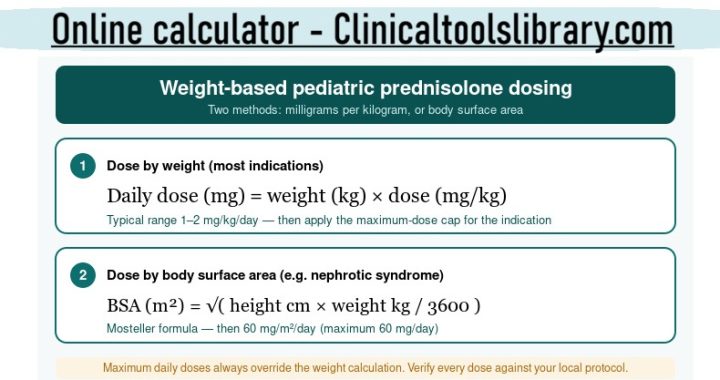
Pediatric corticosteroid doses are almost always weight-based, because children vary enormously in size and a fixed adult dose would be unsafe. The calculator multiplies the child’s weight in kilograms by the dose in milligrams per kilogram (mg/kg) you select for the indication, then caps the result at the guideline maximum so the dose never exceeds the recommended ceiling. For some indications most importantly the initial treatment of nephrotic syndrome dosing is based on body surface area (BSA) instead, which the tool estimates with the Mosteller formula.

Why the cap matters: weight-based formulas break down at the upper end. A 50 kg adolescent at 2 mg/kg would calculate to 100 mg, far more than is needed or safe for asthma. Above a certain dose there is no extra benefit, only added toxicity, so the tool shows both the raw calculated dose and the capped dose. It also converts the final dose into millilitres for common liquid concentrations or into 5 mg tablets, because dispensing the wrong strength of liquid is a well-documented source of error. For body surface area work and steroid switches, see our body surface area (Mosteller) calculator and corticosteroid equivalence calculator.
Prednisolone dosing by indication in children
The table below summarises the guideline dosing the calculator applies. These figures are a reference for qualified prescribers; always confirm against your local formulary.
| Indication | Dose | Maximum / day | Duration | Guideline |
|---|---|---|---|---|
| Acute asthma exacerbation | 1–2 mg/kg/day | 20 mg (<2 y), 30 mg (2–5 y), 40 mg (6–11 y) | 3–5 days, no taper | GINA 2025 |
| Croup (first-line: dexamethasone) | Dexamethasone 0.15–0.6 mg/kg single dose; prednisolone 1–2 mg/kg if unavailable | Dexamethasone 16 mg | Single dose | Cochrane 2023 |
| Nephrotic syndrome (initial) | 60 mg/m²/day or 2 mg/kg/day | 60 mg | 4–6 wk daily, then alternate-day; ≤12 wk total | KDIGO 2021 |
| Immune thrombocytopenia (ITP) | 2–4 mg/kg/day | 120 mg | 5–7 days | ASH 2019 |
| General anti-inflammatory | 0.5–2 mg/kg/day | ~60 mg (verify per condition) | Condition-dependent | BNF for Children |
Prednisolone dose for a child with asthma
For acute asthma, GINA 2025 recommends an oral corticosteroid equivalent to prednisolone 1–2 mg/kg each morning for 3–5 days. The daily maximum is age-banded: 20 mg under 2 years, 30 mg for ages 2–5, and 40 mg for ages 6–11. A point worth flagging is that guidelines disagree on the ceiling: the older US NHLBI/EPR-3 guidance allows up to 60 mg/day, so follow your local protocol. Short courses do not need tapering, and a randomised trial found 1 mg/kg/day was non-inferior to 2 mg/kg/day with less vomiting in preschool children.
Croup: dexamethasone first, prednisolone as an alternative
For croup, a single dose of dexamethasone is first-line because of its long half-life and better tolerability. The 2023 Cochrane review of 45 trials in 5,888 children confirms glucocorticoids reduce symptoms and return visits, and that 0.15 mg/kg is as effective as 0.6 mg/kg. Prednisolone 1–2 mg/kg is an accepted alternative when dexamethasone is unavailable, though re-presentation may be slightly higher. Our dose calculator shows both dexamethasone options alongside the prednisolone alternative; for a dedicated tool see the dexamethasone croup dose calculator.
Nephrotic syndrome dose (KDIGO)
For a first presentation of childhood nephrotic syndrome, KDIGO 2021 recommends prednisone or prednisolone at 60 mg/m²/day or 2 mg/kg/day (maximum 60 mg/day) as a single daily dose for 4–6 weeks, followed by alternate-day dosing, with total initial therapy not exceeding 12 weeks. This is where BSA-based dosing matters most: in young, small children the mg/kg method can under-dose, so the calculator computes the Mosteller BSA dose for comparison.
Immune thrombocytopenia (ITP) dose
For newly diagnosed pediatric ITP requiring treatment, the American Society of Hematology 2019 guidelines suggest prednisone or prednisolone 2–4 mg/kg/day (maximum 120 mg/day) for 5–7 days. Children with no or mild bleeding are usually observed rather than treated, because most recover within months without intervention.
Prednisolone vs prednisone vs dexamethasone
Prednisolone is the active drug; prednisone is a prodrug the liver converts into prednisolone, so the two are equal milligram-for-milligram. Prednisolone is generally preferred in young children because it does not depend on hepatic conversion and is widely available as a palatable liquid. Dexamethasone is far more potent and much longer-acting, which is why its doses look smaller and a single dose can cover croup. The table compares anti-inflammatory equivalence.
| Corticosteroid | Equivalent dose | Half-life | Mineralocorticoid effect |
|---|---|---|---|
| Hydrocortisone | 20 mg | 8–12 h (short) | High |
| Prednisolone | 5 mg | 12–36 h | Low |
| Prednisone | 5 mg | 12–36 h | Low |
| Methylprednisolone | 4 mg | 12–36 h | Minimal |
| Dexamethasone | 0.75 mg | 36–72 h (long) | None |
So prednisolone 5 mg is roughly equivalent to dexamethasone 0.75 mg. This equivalence reflects anti-inflammatory potency only and does not adjust for mineralocorticoid effect or onset, and it is not valid for adrenal replacement.
Prednisolone side effects and safety in children
Side effects of a short course
Short courses are usually well tolerated. A systematic review of short-course oral corticosteroids in children found the most common reactions were vomiting (about 5%), behavioural or mood changes (about 5%) and disturbed sleep (about 4%); increased appetite and abdominal pain also occur. Serious infection was uncommon (around 1%). Most effects resolve once the medicine is stopped.
Tapering and the HPA axis
Short courses do not need tapering. Tapering becomes important for courses longer than about two weeks, or repeated courses, to let the adrenal (HPA) axis recover and avoid adrenal insufficiency. Giving the dose once in the morning mimics the body’s natural cortisol rhythm and reduces both HPA-axis suppression and insomnia.
Vaccines, chickenpox and measles
Chickenpox and measles can be more severe in non-immune children taking corticosteroids. If a non-immune child on steroids is exposed, seek advice promptly — post-exposure immunoglobulin may be indicated. Live vaccines (such as MMR and varicella) are contraindicated at immunosuppressive doses, broadly 2 mg/kg/day or 20 mg/day for two weeks or more; inactivated vaccines can be given but the response may be reduced. Always check local immunisation guidance.
Prednisolone for children: information for parents and caregivers
Prednisolone liquid is bitter, so give it with food or milk and offer a favourite drink straight afterwards; ask your pharmacist about a less bitter formulation or soluble tablets if your child resists. Use the oral syringe supplied with the medicine to measure the dose — not a kitchen spoon — because liquid strengths differ between products. If your child is sick within 30 minutes of a dose you may be advised to repeat it; after 30 minutes, wait for the next scheduled dose. If you miss a dose, give it when you remember the same day, but never give a double dose. It usually starts working within a few hours, with the full effect over a day or two. Reputable patient information is available from Nationwide Children’s Hospital.
Frequently asked questions
What is the prednisolone dose for a child with asthma?
GINA 2025 recommends prednisolone 1–2 mg/kg each morning for 3–5 days, capped at 20 mg/day under 2 years, 30 mg/day for ages 2–5 and 40 mg/day for ages 6–11. Some US guidance allows up to 60 mg/day. A prescriber must set the exact dose.
How much prednisolone for a 2-year-old?
At roughly 12–14 kg, a 1–2 mg/kg/day asthma dose works out to about 12–28 mg/day, capped at 30 mg/day for ages 2–5 under GINA. The dose must be individualised by a clinician and is not a do-it-yourself calculation.
What is the difference between prednisolone and prednisone?
Prednisone is a prodrug the liver converts into the active drug, prednisolone. They are equivalent milligram-for-milligram. Prednisolone is preferred in young children and in liver impairment.
Is prednisolone the same as dexamethasone?
No. Prednisolone 5 mg is roughly equivalent to dexamethasone 0.75 mg in anti-inflammatory potency. Dexamethasone is more potent and much longer-acting, which is why it is first-line for croup as a single dose.
Does prednisolone need to be tapered in children?
Not for short courses. Tapering is generally reserved for courses longer than about two weeks, or repeated courses, to allow the HPA axis to recover.
What are the side effects of prednisolone in children?
Short courses most often cause vomiting, mood or behaviour changes, disturbed sleep and increased appetite. These usually settle after the medicine stops. Prolonged use can affect growth, bones and the immune system, which is why long courses are monitored.
Can a child have vaccines while on prednisolone?
Inactivated vaccines can be given, though the response may be reduced. Live vaccines are contraindicated at immunosuppressive doses (broadly 2 mg/kg/day or 20 mg/day for two weeks or more). Short low-dose courses are usually not a barrier — check local guidance.
How long does prednisolone take to work in a child?
It usually begins reducing inflammation within a few hours, with the full effect over one to two days. In asthma it is given early alongside, not instead of, bronchodilators.
Sources and references
- Global Initiative for Asthma. GINA reports and 2025 strategy.
- Aregbesola A, et al. Glucocorticoids for croup in children. Cochrane Database Syst Rev 2023;1:CD001955.
- KDIGO 2021 Clinical Practice Guideline for the Management of Glomerular Diseases. Kidney International.
- Neunert C, et al. ASH 2019 guidelines for immune thrombocytopenia. Blood Adv 2019;3(23):3829.
- Patient information: Nationwide Children’s Hospital — Prednisone and Prednisolone.
Medical disclaimer. This page is an educational reference published by clinicaltoolslibrary.com for healthcare professionals and informed caregivers. It is not medical advice, a diagnosis or a prescription. Dosing must be individualised by a qualified prescriber and verified against current guidelines and the product label. Anything described as investigational or off-label is noted as such. If you are a parent or caregiver, follow the instructions given by your child’s clinician.