The number of calories burned skiing depends on three things: your body weight, how hard you ski, and how long you stay active on the snow. The calculator on this page combines those inputs with research-based MET values to give a fast, personalised estimate, and the chart and explanations below show how the figures are worked out so you can sanity-check any result.
Calories Burned Skiing Calculator
Estimate the energy you use skiing, from MET values in the 2024 Adult Compendium of Physical Activities. Enter your weight, ski type, effort and active time.
Estimated energy used
Active time vs lift & rest
A common mistake is counting the whole day as skiing. Only active time burns at the MET rate above.
The math
How it is calculated
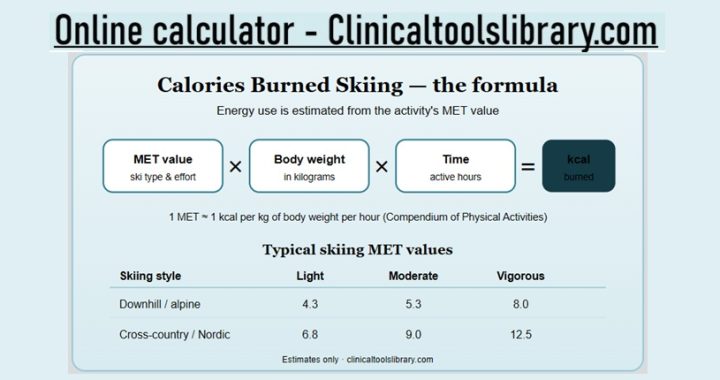
Energy use is estimated from the MET (metabolic equivalent of task) of the activity. One MET is the energy of sitting quietly, defined as 1 kcal per kilogram of body weight per hour. So calories ≈ MET × weight (kg) × time (hours). An equivalent oxygen-uptake form, (MET × 3.5 × kg) ÷ 200 per minute, is used here as an independent check; the two agree within about 5%.
Intensity (CDC): light is below 3 METs, moderate is 3.0–5.9 METs, and vigorous is 6.0 METs or more. Most skiing is moderate-to-vigorous.
Skiing MET values — 2024 Adult Compendium
| Activity | Code | MET |
|---|---|---|
| Downhill / alpine, light effort (active time) | 19150 | 4.3 |
| Downhill / alpine, moderate / general (active time) | 19160 | 6.3 |
| Downhill / alpine, vigorous effort (active time) | 19170 | 8.0 |
| Alpine skiing, high-intensity training | 19174 | 7.3 |
| Skiing, slalom | 19146 | 9.3 |
| Skiing, general | 19075 | 7.0 |
| Cross-country, slow / ski-walking ~2.5 mph | 19080 | 6.8 |
| Cross-country, moderate 4–4.9 mph | 19090 | 8.5 |
| Cross-country, brisk / vigorous 5–7.9 mph | 19100 | 11.3 |
| Cross-country, skating technique | 19135 | 13.3 |
| Cross-country, elite racing >8 mph | 19110 | 14.0 |
| Cross-country, hard snow uphill, maximum | 19130 | 15.5 |
| Snowboarding, recreational, moderate | 19201 | 7.5 |
Note: 2024 values differ from the older 2011 set (for example, downhill moderate rose from 5.3 to 6.3 MET). This tool covers snow skiing only — water-skiing and jet-skiing are different activities and are out of scope.
Sources
- Herrmann SD, Willis EA, Ainsworth BE, et al. 2024 Adult Compendium of Physical Activities — Winter Activities (MET values & codes).
- Herrmann SD, et al. 2024 Adult Compendium of Physical Activities: a third update of the energy costs of human activities. J Sport Health Sci. 2024.
- Centers for Disease Control and Prevention. How to Measure Physical Activity Intensity (MET & intensity bands).
- Centers for Disease Control and Prevention. What Counts as Physical Activity for Adults (weekly activity targets).
Full disclaimer & reporting
This calculator is an educational reference published by clinicaltoolslibrary.com. It estimates energy expenditure from population-level MET values and does not provide medical, dietary or training advice, diagnosis or treatment.
Results are estimates only. Real energy use varies with fitness, technique, terrain, snow, altitude, cold, equipment and the proportion of time spent actively skiing. MET values were measured in adults aged 19–59 and may not represent children, older adults, pregnancy or specific medical conditions. Always confirm figures and follow the guidance of a qualified clinician, dietitian or coach before making health, weight or training decisions.
Found an error in the tool or a figure? Please report it to clinicaltoolslibrary.com so it can be reviewed. For health symptoms during or after exercise, seek advice from a healthcare professional.
Estimates based on the 2024 Adult Compendium of Physical Activities · clinicaltoolslibrary.com
How the calories burned skiing calculator works
Every estimate of calories burned skiing starts from a MET (metabolic equivalent of task) value. One MET is roughly the energy your body uses sitting quietly, defined as about 1 kcal per kilogram of body weight per hour. An activity rated at 5 METs therefore uses about five times that resting energy. The MET figures used here come from the Compendium of Physical Activities, the standard reference exercise scientists use to quantify energy cost.

The MET formula behind your estimate
The calculator uses the simplest accepted version of the energy equation:
Calories ≈ MET × body weight (kg) × time (hours)
For example, a 70 kg (154 lb) skier doing typical recreational downhill runs (MET 5.3) for one active hour would use roughly 5.3 × 70 × 1 ≈ 370 kcal. Some tools instead use the oxygen-uptake form, (MET × 3.5 × kg) ÷ 200 per minute, which lands within a few percent of the same answer. Either way the result is an estimate, not a lab measurement.
Why “active time” matters more than clock time
Published MET values for downhill skiing describe active descents only — the minutes you are actually moving down the hill. A real resort day mixes those descents with chairlift rides, queues, lunch and standing around, so your average burn per clock hour is lower than the table suggests. If you want a figure that includes lift time, estimate only the time you spend actively skiing (often a fraction of the day) rather than the full time the lifts are open. Cross-country skiing tends to be far more continuous, so active time and clock time are much closer.
Calories burned skiing per hour by body weight
The chart below shows approximate calories burned per active hour for the most common skiing styles and effort levels, across a range of body weights. Heavier skiers and harder efforts burn more; lighter skiers and gentle cruising burn less. Use these as planning estimates and scale up or down for your own weight.
| Skiing style & effort (MET) | 60 kg (132 lb) |
70 kg (154 lb) |
80 kg (176 lb) |
90 kg (198 lb) |
|---|---|---|---|---|
| Downhill / alpine, light cruising (4.3) | 260 | 300 | 345 | 385 |
| Downhill / alpine, moderate recreational (5.3) | 320 | 370 | 425 | 475 |
| Downhill / alpine, vigorous · racing, moguls (8.0) | 480 | 560 | 640 | 720 |
| Cross-country, light · ski-walking ~2.5 mph (6.8) | 410 | 475 | 545 | 610 |
| Cross-country, moderate ~4–5 mph (9.0) | 540 | 630 | 720 | 810 |
| Cross-country, vigorous · brisk 5–8 mph (12.5) | 750 | 875 | 1000 | 1125 |
Figures are rounded estimates of energy used during active skiing. Individual results vary widely with fitness, terrain, altitude, cold, technique and equipment, so treat any single number as a ballpark.
How your skiing style changes the calorie burn
Not all skiing is equal. The discipline and how hard you push both shift the MET value, which is why a relaxed groomer day and a cross-country tour can differ by hundreds of calories an hour.
Downhill (alpine) skiing
Recreational downhill skiing sits at roughly MET 5.3 for moderate effort, dropping to about 4.3 for easy cruising and rising to around 8.0 for vigorous, racing-style descents. Because gravity does much of the work on the way down, the per-active-hour burn is moderate, and the long pauses on lifts pull a full day’s average lower still. Most recreational alpine skiers land somewhere around 300–500 calories per active hour depending on weight and intensity.
Cross-country (Nordic) skiing
Cross-country skiing is one of the most demanding endurance activities measured, because you propel yourself the whole time using arms, legs and core. Moderate Nordic skiing is about MET 9.0 and brisk skiing reaches 12.5 or higher, so it commonly burns 600–900+ calories per hour. That continuous, full-body effort is why cross-country skiing usually tops the calories-burned table among snow sports.
Other styles: ski touring, backcountry, skate skiing and ski machines
Ski touring and backcountry skiing add uphill climbing under your own power, which raises the effort well above lift-served runs. Skate skiing is a vigorous Nordic technique with MET values in the low-to-mid teens. Indoor Nordic-style ski machines fall closer to general cross-country effort and depend heavily on resistance and pace. For any of these, pick the closest matching style and effort in the calculator and adjust the duration to your actual moving time. For the uphill climbing portion of ski touring, our calories burned hiking calculator offers a useful comparison.
What affects how many calories you burn skiing
Several factors push your real-world burn above or below the chart:
- Body weight: heavier skiers move more mass, so energy use scales roughly in proportion to weight.
- Effort and intensity: bumps, powder, steeps and faster speeds raise the MET; gentle blue runs lower it.
- Active vs. total time: lift rides, queues and rest reduce the average over a full day on the mountain.
- Skill level: beginners often work harder per descent through falls, sidestepping and tension, while efficient experts may use less energy at the same speed.
- Cold and altitude: staying warm and breathing thinner mountain air can modestly increase energy demand.
- Terrain and technique: carving, traversing and poling all change how much muscle you recruit.
Skiing easily clears the activity bar in the U.S. physical activity guidelines, which recommend 150 minutes of moderate or 75 minutes of vigorous activity each week. If you want to know how your daily totals fit your goals, pair this estimate with our daily calorie needs (TDEE) calculator.
Frequently asked questions
How many calories does skiing burn?
Most recreational downhill skiers burn roughly 300–500 calories per active hour, while cross-country skiing typically burns 600–900 or more. The exact number depends on your body weight, effort level and how much of your time is spent actively skiing rather than riding lifts.
Does skiing burn a lot of calories?
Yes. Skiing is a genuine moderate-to-vigorous workout. A typical day of active downhill skiing can use well over 1,000 calories, and a few hours of cross-country skiing can burn even more, making it one of the more effective winter activities for energy expenditure.
How many calories do you burn skiing per hour?
For a 70 kg (154 lb) person, expect about 300 kcal per active hour cruising gently downhill, around 370 kcal at a moderate recreational pace, and 600–875 kcal per hour cross-country skiing. Heavier skiers and harder efforts burn more; see the chart above for other weights.
How many calories do you burn in a day of skiing?
A full day on the slopes commonly burns somewhere between 1,000 and 3,000 calories. The wide range reflects how much of the day is actual skiing versus lift time and breaks, plus your weight, intensity and the terrain you ski.
How many calories does cross-country skiing burn?
Cross-country skiing burns roughly 540–810 calories per hour at a moderate pace and 750–1,125 calories per hour when brisk, for skiers between 60 and 90 kg. Because it is continuous and uses the whole body, it usually burns more than downhill skiing.
Do you burn more calories skiing or snowboarding?
At the same intensity they are very close: the Compendium of Physical Activities assigns downhill skiing and snowboarding the same moderate MET value of about 5.3. Any real difference comes from how much active time and effort each session involves, not the sport itself. To compare the two directly, try our calories burned snowboarding calculator.
Does jet skiing or water skiing burn calories?
Both burn calories, but far less than snow skiing in most cases. Recreational jet skiing and water skiing are usually light-to-moderate activities driven mainly by core and grip effort; this calculator is built for snow skiing, so use a dedicated water-sports estimate for those activities.
Sources & further reading
- Herrmann SD, et al. 2024 Adult Compendium of Physical Activities — MET values for skiing and other activities.
- Herrmann SD, et al. 2024 Adult Compendium of Physical Activities: a third update of the energy costs of human activities (peer-reviewed, NIH/PMC).
- Centers for Disease Control and Prevention. How to Measure Physical Activity Intensity — definition of METs and intensity.
- Centers for Disease Control and Prevention. What Counts as Physical Activity for Adults — weekly activity guidelines.