The empty can test also called the Jobe test is the single most-searched shoulder examination manoeuvre, and on its own it tells you far less than most clinicians assume. This page explains how to perform it, what counts as a positive result, and how its published likelihood ratios convert a pre-test probability into a post-test probability. The calculator above does that arithmetic for the empty can test alongside the Neer, Hawkins-Kennedy, full can and painful arc tests, using data from arthroscopy- and MRI-verified cohorts.
Clinical Tools Library · Shoulder examination
Shoulder Impingement Special Tests
Neer, Hawkins-Kennedy, painful arc, empty can (Jobe), full can and the rest — turned into a post-test probability using published likelihood ratios. Enter a pre-test probability, record what you found, and see exactly how far the examination moved you.
Who is using this tool?
Clinician view: compact, assumes you performed and interpreted the tests yourself.
Screen for red flags first
Stop and reassess if any apply
Choose the question and the evidence behind it
Pre-test probability *required
Your judgement, informed by age, mechanism, occupation, symptom duration and local prevalence. The published cohort prevalences above are a starting point, not your patient.
Record your findings
Leave a test as Not done if you did not perform it. Never enter a result you did not personally elicit.
How should the findings be combined?
The error this tool exists to prevent
Same arm, same downward force — thumb down or thumb up changes what you are testing
The empty can and full can tests use the same 90° of elevation in the scapular plane. Only humeral rotation differs. Yet the position, and the criterion you accept as "positive", change the numbers substantially. Kelly and colleagues showed supraspinatus EMG activity is comparable in both positions while the full can provokes less pain — which is why weakness, not pain, is the more meaningful finding.
The painful arc
Technique, positive criterion, and what it is thought to load
Individual tests
Reported accuracy by cohort
| Test | Target condition & cohort | Sens | Spec | LR+ | LR− |
|---|
Clusters
Combinations validated as combinations
| Cluster | Rule | LR | Source |
|---|---|---|---|
| Hawkins-Kennedy + Neer + painful arc + empty can + external rotation resistance | ≥3 of 5 positive | LR+ 2.93 (1.60–5.36) LR− 0.34 (0.14–0.80) | Michener 2009 (SAIS) |
| Hawkins-Kennedy + painful arc + infraspinatus strength | 3 of 3 positive | LR+ 10.56 | Park 2005 (any impingement) |
| Hawkins-Kennedy + painful arc + infraspinatus strength | 2 of 3 positive | LR+ 5.03 | Park 2005 |
| Hawkins-Kennedy + painful arc + infraspinatus strength | 0 of 3 positive | LR 0.17 | Park 2005 |
| Painful arc + drop-arm + infraspinatus strength | 3 of 3 positive | LR+ 15.57 | Park 2005 (full-thickness tear) |
Park reported a post-test probability of 95% for any degree of impingement when all three of Hawkins-Kennedy, painful arc and infraspinatus were positive, and 91% for a full-thickness tear with the painful arc, drop-arm and infraspinatus combination — both computed against that cohort's own prevalence, not yours.
Interpreting a likelihood ratio
| LR+ | Effect on probability | LR− | Effect on probability |
|---|---|---|---|
| > 10 | Large, often conclusive increase | < 0.1 | Large, often conclusive decrease |
| 5 – 10 | Moderate increase | 0.1 – 0.2 | Moderate decrease |
| 2 – 5 | Small increase | 0.2 – 0.5 | Small decrease |
| 1 – 2 | Minimal; rarely changes management | 0.5 – 1 | Minimal; rarely changes management |
Last reviewed: July 2026
Sources
- Park HB, Yokota A, Gill HS, El Rassi G, McFarland EG. Diagnostic accuracy of clinical tests for the different degrees of subacromial impingement syndrome. J Bone Joint Surg Am. 2005;87(7):1446–55. PMID 15995110 — sensitivity/specificity of eight tests in 552 arthroscopically verified patients; cluster likelihood ratios.
- Michener LA, Walsworth MK, Doukas WC, Murphy KP. Reliability and diagnostic accuracy of 5 physical examination tests and combination of tests for subacromial impingement. Arch Phys Med Rehabil. 2009;90(11):1898–903. PMID 19848251 — the 3-of-5 cluster; surgical reference standard.
- Alqunaee M, Galvin R, Fahey T. Diagnostic accuracy of clinical tests for subacromial impingement syndrome: a systematic review and meta-analysis. Arch Phys Med Rehabil. 2012;93(2):229–36. PMID 22289231 — pooled estimates used here for Hawkins-Kennedy, Neer, empty can, drop-arm and lift-off.
- Itoi E, Kido T, Sano A, Urayama M, Sato K. Which is more useful, the "full can test" or the "empty can test," in detecting the torn supraspinatus tendon? Am J Sports Med. 1999;27(1):65–8. PMID 9934421 — pain versus weakness as the positive criterion.
- Jain NB, Luz J, Higgins LD, et al. The diagnostic accuracy of special tests for rotator cuff tear: the ROW cohort study. Am J Phys Med Rehabil. 2017;96(3):176–83. PMID 27386812 — Jobe, full can and drop-arm for supraspinatus tear.
- Hanchard NCA, Lenza M, Handoll HHG, Takwoingi Y. Physical tests for shoulder impingements and local lesions of bursa, tendon or labrum that may accompany impingement. Cochrane Database Syst Rev. 2013;(4):CD007427. PMID 23633343 — insufficient evidence to select physical tests in primary care.
- Zhao Q, Palani P, Kassab NS, et al. Evidence-based approach to the shoulder examination for subacromial bursitis and rotator cuff tears: a systematic review and meta-analysis. BMC Musculoskelet Disord. 2024;25:1028. PMID 39702033 — a large body of low-quality evidence; roughly two thirds of primary-care shoulder pain is rotator-cuff related.
- Hegedus EJ, Goode AP, Cook CE, et al. Which physical examination tests provide clinicians with the most value when examining the shoulder? Update of a systematic review with meta-analysis of individual tests. Br J Sports Med. 2012;46(14):964–78. PMID 22773322 — context on the limited accuracy of individual impingement tests.
- Kelly BT, Kadrmas WR, Speer KP. The manual muscle examination for rotator cuff strength. An electromyographic investigation. Am J Sports Med. 1996;24(5):581–8. PMID 8883676 — rationale for the full can position.
Full disclaimer, limitations and how to report an error
This is an educational reference and decision aid. It is not medical advice, it is not a diagnosis, and it does not recommend any treatment, imaging or referral. It performs one calculation — Bayes' theorem in odds form — on numbers that you supply. Its output is only as good as your pre-test probability and the accuracy with which the tests were performed.
Known limitations. (1) The likelihood ratios come from cohorts examined mostly in secondary and tertiary care, with arthroscopy, surgery or MRI as the reference standard; they may not transfer to primary care. (2) "Subacromial impingement syndrome" is a contested label; much current writing prefers subacromial pain syndrome or rotator-cuff-related shoulder pain, because these tests do not reliably identify a single anatomical structure. (3) Inter-examiner agreement for the Neer and Hawkins-Kennedy tests is only fair. (4) Multiplying likelihood ratios from tests performed on the same shoulder assumes conditional independence, which is untrue; the tool warns you and caps nothing — you must interpret it. (5) A low post-test probability does not exclude a tear, and a high one does not establish one.
No recommendations are given. Whether to image, inject, refer or rehabilitate is a clinical decision for the treating clinician with the whole patient in front of them, following current local guidance.
Reporting problems. If you believe a figure, formula or citation on this page is wrong, please contact Clinical Tools Library through the site's contact page so it can be corrected and the review date updated. Adverse events related to a medical device or product should be reported to your national authority — in the United States via FDA MedWatch, in the United Kingdom via the MHRA Yellow Card scheme, and in the EU via your national competent authority.
Privacy. Nothing you type leaves your browser. Your last selections (evidence set, pre-test probability, test results, theme) are stored in this browser's local storage so the tool reopens where you left it. No patient identifiers are ever requested or stored. Use the reset button to clear them.
Educational reference, not medical advice. Nothing here is a diagnosis or a treatment recommendation. Physical examination cannot confirm or exclude a rotator cuff tear. Confirm every figure against the cited primary sources and follow your treating clinician and current local guidance.
How the empty can test calculator works
A special test does not produce a probability. It produces a shift in probability. The calculator applies Bayes’ theorem in odds form: your pre-test probability is converted to odds, multiplied by the likelihood ratio for the result you recorded, and converted back to a probability.

Two inputs matter more than the test itself. The first is your pre-test probability: the same positive empty can test means something entirely different in a 24-year-old swimmer and a 68-year-old with three months of night pain. The second is the criterion you accept as positive — pain, weakness, or either. The calculator refuses to compute until you explicitly confirm a pre-test probability, because a silently defaulted 50% produces a number that looks authoritative and means nothing.
Performing the Jobe (empty can) test
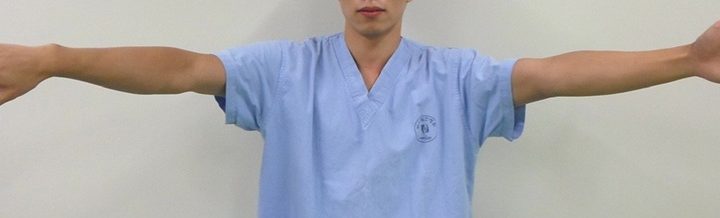
- Position the arm at 90° of elevation in the scapular plane, roughly 30° anterior to the frontal plane.
- Fully internally rotate the humerus so the thumb points to the floor — the “empty can” position.
- Apply a downward force at the wrist or distal forearm while the patient resists.
- Record what you elicited: pain, weakness, both, or neither. Compare with the unaffected side.
Pain or weakness: which one counts as positive?
This is where the manoeuvre is most often misread. In Itoi’s MRI-verified series of 143 shoulders, treating pain as positive gave a positive likelihood ratio of about 1.4 — essentially uninformative. Treating weakness as positive gave roughly 2.4. The empty can position is provocative, so pain can produce give-way weakness in a perfectly intact tendon, and pain alone in a shoulder that hurts on almost any loaded manoeuvre adds very little.
Weakness is not always a tendon. Weakness in the empty can and full can positions failed to distinguish rotator cuff tears from cervical spondylotic amyotrophy in a direct comparison. Before attributing weakness to the supraspinatus, examine the cervical spine and consider C5–C6 radiculopathy, suprascapular neuropathy and neuralgic amyotrophy.
Empty can, full can, Neer, Hawkins-Kennedy and the painful arc
These five manoeuvres are usually taught together and are best interpreted together. None reaches the conventional likelihood ratio of 10 that would let a single test rule a condition in.
Full can test
Identical arm elevation, but with the humerus externally rotated about 45° so the thumb points up. Supraspinatus EMG activity is comparable to the empty can position while pain provocation is lower, which is why weakness is the meaningful finding and why inter-observer agreement is better. In the ROW cohort the full can test had a sensitivity of 70% and a specificity of 81% for a supraspinatus tear.
Neer impingement sign
The examiner stabilises the scapula and passively forward-flexes the arm until pain is reported. Sensitive but poorly specific: pooled estimates are around 78% and 58%, giving a positive likelihood ratio of 1.86 — a positive result barely moves the needle, while a negative one is modestly reassuring.
Hawkins-Kennedy test
The arm is elevated to 90° of forward flexion with the elbow flexed, then forcibly internally rotated. Pooled sensitivity 74%, specificity 57%. Inter-rater agreement for both the Neer and Hawkins-Kennedy tests is only fair, which is part of why their accuracy figures vary so widely between studies.
Painful arc sign
The patient actively elevates the arm in the scapular plane and lowers it through the same arc. Positive when pain or painful catching occurs between roughly 60° and 120° of elevation. In Park’s surgical cohort of 552 patients it was the most sensitive single test (73.5%) with the highest overall accuracy, and it appears in both of the validated clusters below.
Diagnostic accuracy and likelihood ratios
| Test | Sensitivity | Specificity | LR+ | Cohort |
|---|---|---|---|---|
| Empty can test (weakness) | 77% | 68% | 2.41 | Itoi 1999, full-thickness supraspinatus tear, MRI |
| Jobe test (pain only) | 63% | 55% | 1.40 | Itoi 1999 |
| Jobe test, single-arm | 88% | 62% | 2.30 | ROW cohort 2017, rotator cuff tear |
| Jobe test (pooled) | 69% | 62% | 1.81 | Alqunaee 2012 meta-analysis, subacromial impingement |
| Full can test (weakness) | 77% | 74% | 2.96 | Itoi 1999 |
| Full can test | 70% | 81% | 3.68 | ROW cohort 2017 |
| Neer sign (pooled) | 78% | 58% | 1.86 | Alqunaee 2012 |
| Hawkins-Kennedy (pooled) | 74% | 57% | 1.70 | Alqunaee 2012 |
| Painful arc sign | 73.5% | 81.1% | 3.89 | Park 2005, arthroscopy, any rotator cuff disease |
| Drop-arm sign | 21% | 92% | 2.62 | Alqunaee 2012 |
Test clusters outperform any single test
Because these manoeuvres load overlapping tissues in overlapping positions, their errors correlate. Multiplying individual likelihood ratios therefore overstates certainty. Only combinations that were validated as combinations should be used:
- Michener 3-of-5: Hawkins-Kennedy, Neer, painful arc, empty can and external rotation resistance. Three or more positive gives LR+ 2.93; fewer than three gives LR 0.34.
- Park 3-of-3: Hawkins-Kennedy, painful arc and infraspinatus strength. All three positive gives LR+ 10.56 and a post-test probability of 95% in that cohort; all three negative gives LR 0.17.
- Park full-thickness cluster: painful arc, drop-arm and infraspinatus strength, all positive, gives LR+ 15.57 for a full-thickness tear.
What the evidence base will not support
The 2013 Cochrane review of physical tests for shoulder impingement concluded there was insufficient evidence on which to base the selection of any of these tests in primary care, largely because studies performed and interpreted them so differently. A 2024 systematic review and meta-analysis reached a similar verdict: a large body of low-quality evidence. Use these manoeuvres to make your reasoning explicit, not to make it certain. If a tear would change management, image it.
Frequently asked questions
What is a positive empty can test?
A positive result is pain, weakness, or an inability to hold the arm against downward pressure at 90° of scapular-plane elevation with the humerus fully internally rotated. Weakness is the more meaningful criterion: it carries a positive likelihood ratio of about 2.4 for a torn supraspinatus, compared with about 1.4 for pain alone.
What does the empty can test indicate?
It indicates possible supraspinatus tendon pathology or subacromial pain. It cannot distinguish tendinopathy, bursitis, a partial-thickness tear and a full-thickness tear, and weakness in this position may instead reflect cervical radiculopathy or suprascapular neuropathy.
What is the difference between the empty can and full can test?
Only humeral rotation. The empty can uses full internal rotation (thumb down); the full can uses about 45° of external rotation (thumb up). Supraspinatus activation is comparable, but the full can provokes less pain, has better inter-observer agreement, and is more specific — 81% versus 62% in the ROW cohort.
How accurate is the Neer test?
Pooled sensitivity is about 78% and specificity about 58%, giving a positive likelihood ratio of 1.86 and a negative likelihood ratio of 0.37. A positive Neer test changes probability very little; a negative one lowers it modestly.
Is the Hawkins-Kennedy test better than the Neer test?
Not meaningfully. Pooled likelihood ratios are 1.70 for Hawkins-Kennedy and 1.86 for Neer — both in the band where a test rarely changes management. Both have only fair inter-rater reliability. Their value lies in contributing to a validated cluster rather than standing alone.
What is the painful arc sign?
Pain or painful catching between approximately 60° and 120° of active elevation in the scapular plane, easing above and below that band. With a positive likelihood ratio near 3.9 in Park’s arthroscopy cohort, it is one of the more informative single manoeuvres available.
Can these tests diagnose a rotator cuff tear?
No. No single shoulder special test reaches a likelihood ratio of 10, the conventional threshold for ruling a condition in. Even the strongest validated cluster shifts probability rather than establishing a diagnosis. Ultrasound or MRI remains the reference standard when the answer would change management.
Related clinical tools and further reading
Score the functional impact of the shoulder alongside the examination with our SPADI shoulder pain and disability index calculator, track upper-limb function with the QuickDASH calculator, and rule out serious pathology first using the shoulder pain red flags checklist.
Primary sources for the figures on this page: Itoi 1999 (Am J Sports Med), Park 2005 (J Bone Joint Surg Am), Michener 2009 (Arch Phys Med Rehabil), Alqunaee 2012 meta-analysis and the ROW cohort study (Jain 2017).