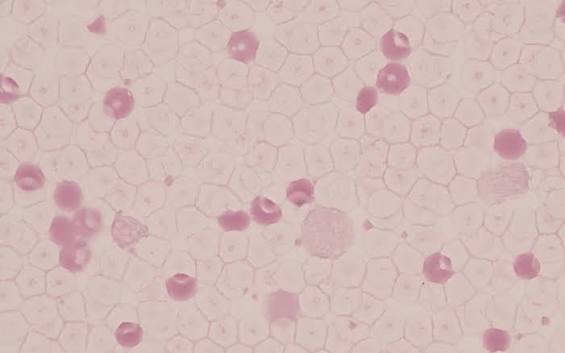
The Kleihauer-Betke test calculator above converts a reported percentage of fetal cells into an estimated volume of fetomaternal hemorrhage (FMH) and the corresponding number of Rho(D) immune globulin (RhoGAM) vials. This page is an educational reference that explains how the Kleihauer-Betke test works, the formula behind it, and how clinicians read the result it is not medical advice or a prescription. Always follow your laboratory report and prescriber, and confirm any figure before it is used in patient care.
What is the Kleihauer-Betke test?
The Kleihauer-Betke test is the long-established laboratory method for detecting and measuring fetomaternal hemorrhage — the passage of fetal red blood cells into the maternal circulation. First described in 1957 by Enno Kleihauer and Klaus Betke, it remains the most widely used quantitative test for this purpose in the United States, according to a StatPearls review hosted by the NIH National Library of Medicine. Its main clinical role is to estimate how much fetal blood has crossed into the mother so that the correct dose of Rho(D) immune globulin can be given to an Rh-negative mother and prevent Rh D alloimmunization.
Because as little as 0.01–0.03 mL of fetal blood can trigger maternal sensitization, accurate quantification matters. Fetomaternal hemorrhage is often silent and can follow trauma, placental abruption, intrauterine fetal demise, or invasive procedures such as amniocentesis and chorionic villus sampling.
The principle of the Kleihauer-Betke test
The principle of the Kleihauer-Betke test rests on a simple difference in chemistry: fetal hemoglobin (HbF) resists acid elution, whereas adult hemoglobin (HbA) does not. A maternal blood smear is bathed in an acid buffer that washes hemoglobin out of adult cells, leaving them as pale “ghost” cells, while fetal cells keep their hemoglobin and stain dark rose-pink after counterstaining. A technologist then counts roughly 2,000 cells and records the proportion that are fetal. Modern laboratories may use slightly different buffers or stains, but all rely on this same acid-resistance principle.
When is the Kleihauer-Betke test ordered?
The test is typically ordered for Rh-negative pregnant patients after a potentially sensitizing event, to decide whether more than the standard single RhoGAM dose is needed. Many centers first run a qualitative rosette screening test, then reflex to the quantitative Kleihauer-Betke test if the screen is positive. The American College of Obstetricians and Gynecologists supports quantitative testing to tailor immunoglobulin dosing; see its practice guidance on preventing Rh D alloimmunization.
Kleihauer-Betke test formula and calculation
The Kleihauer-Betke test formula translates the fetal-cell percentage into a blood volume, then into RhoGAM vials. The calculation assumes a maternal blood volume of about 5,000 mL, so each 1% of fetal cells corresponds to roughly 50 mL of fetal whole blood. One standard 300 mcg vial of Rho(D) immune globulin neutralizes about 30 mL of fetal whole blood (15 mL of fetal red cells).

The Kleihauer-Betke test formula
The core equations, as summarized in the peer-reviewed literature indexed on PubMed, are:
- Percentage of fetal cells = (fetal cells × 100) ÷ total red cells counted
- Fetal blood volume (mL) = percentage of fetal cells × 50
- Number of 300 mcg vials = fetal blood volume ÷ 30
- Combined: vials = (percentage of fetal cells × 50) ÷ 30
Worked calculation example
Suppose a laboratory reports 1.7% fetal cells:
- Fetal blood volume = 1.7 × 50 = 85 mL
- Vials = 85 ÷ 30 = 2.83
- The decimal (0.83) is ≥ 0.5, so round up to 3, then add 1 vial → 4 vials
This mirrors the approach used by hospital transfusion services and the American Association of Blood Banks (now the Association for the Advancement of Blood & Biotherapies) technical guidance.
Rounding and RhoGAM dosing rules
| Scenario | Dose | Approximate coverage |
|---|---|---|
| Mini-dose (before 12 weeks) | 150 mcg | ~2.5 mL Rh-positive red cells |
| Standard single dose | 300 mcg (1 vial) | 30 mL fetal whole blood (15 mL fetal red cells) |
| Large fetomaternal hemorrhage | Multiple vials per formula | Guided by Kleihauer-Betke test result |
Timing also matters: Rho(D) immune globulin is generally given within 72 hours of delivery or a sensitizing event. Our related RhoGAM dosing calculator applies these same rules.
Interpreting Kleihauer-Betke test results
Reading Kleihauer-Betke test results centers on the reported fetal-cell percentage and what it implies for immunoglobulin dosing. The interpretation of findings should always be made together with the clinical picture and local laboratory reference ranges.
Normal and positive results
In an unaffected pregnancy, fetal cells are essentially absent from maternal blood; laboratories typically report a normal range of about 0 to 0.1%. A higher percentage indicates a positive result — measurable fetomaternal hemorrhage — and prompts calculation of the additional RhoGAM required. A larger percentage means a larger estimated bleed and, potentially, more vials.
Limitations and false positives
The Kleihauer-Betke test has real limitations: it has relatively low sensitivity, tends to overestimate hemorrhage volume, and is subject to variability between observers because counting is manual. False positives can occur when the mother naturally carries elevated fetal hemoglobin — for example in hereditary persistence of fetal hemoglobin, sickle cell trait or disease, or some thalassemias. Flow cytometry is a more precise, reproducible alternative and is increasingly used; you can read more in our guide to fetomaternal hemorrhage testing or in this open-access comparison study on PubMed Central.
Kleihauer-Betke test: frequently asked questions
What is another name for the Kleihauer-Betke test?
The Kleihauer-Betke test is also called the acid elution test, the KB test, or the KB stain. All refer to the same acid-elution method for detecting fetal red cells in maternal blood.
What is the principle of the Kleihauer-Betke test?
The principle is that fetal hemoglobin (HbF) resists acid elution while adult hemoglobin (HbA) is washed away. After an acid bath and staining, fetal cells appear dark pink and adult cells appear as pale ghosts, allowing the fetal fraction to be counted.
What is a normal Kleihauer-Betke test result?
A normal result shows essentially no fetal cells in maternal blood, usually reported as roughly 0 to 0.1%. Anything above the laboratory’s reference range is considered positive and is used to calculate RhoGAM dosing.
How is the Kleihauer-Betke test calculated?
Multiply the fetal-cell percentage by 50 to estimate fetal blood volume in milliliters, then divide by 30 to get the number of 300 mcg vials. Apply the rounding rule and add one vial for safety. For example, 1.7% gives 85 mL, which is 2.83 vials, rounded to 4 vials.
How accurate is the Kleihauer-Betke test?
It is highly specific but has limited sensitivity and tends to overestimate the bleed. Manual counting introduces observer variability, and maternal conditions with high fetal hemoglobin can cause false positives. Flow cytometry offers greater precision.
Is the Kleihauer-Betke test the same as flow cytometry?
No. Both quantify fetomaternal hemorrhage, but the Kleihauer-Betke test is a manual acid-elution stain, whereas flow cytometry uses labeled antibodies and automated counting for more reproducible results. Many labs use the KB test as a widely available option and flow cytometry when higher precision is needed.
References and further reading
Selected authoritative sources used for this educational reference:
- Kunarathnam V, et al. Kleihauer-Betke Test. StatPearls (NIH National Library of Medicine).
- Kleihauer-Betke Test — PubMed record.
- ACOG: Prevention of Rh D Alloimmunization (Practice Bulletin).
- Prevention of Rh D Alloimmunization — Obstetrics & Gynecology full text.
- Comparison of Kleihauer-Betke test and flow cytometry for FMH — PubMed Central.