This peptide dosage calculator does three jobs: it turns a lyophilized vial into an exact, drawable dose, it converts between insulin-syringe units and a dose, and it dilutes an existing solution using C1V1 = C2V2. Enter the amount of peptide in the vial, the volume of bacteriostatic water you add, and your target dose, and it returns the concentration, the volume to draw, the mark to fill on an insulin syringe, and the number of doses per vial. Below, this peptide dosage calculator guide explains the reconstitution maths it uses, how much diluent to add, how to convert between micrograms, milligrams and insulin units, and how to dilute a solution that is too strong.
It is written as an educational reference for clinicians and informed patients — not medical advice, a prescription, or an endorsement of any compound. Always follow your prescriber or pharmacist and confirm every figure against your product label before drawing or administering anything.
Peptide Reconstitution & Dosage Calculator
Three tools in one: reconstitute a vial into an exact drawable dose, convert between insulin-syringe units and dose, and dilute an existing solution (C₁V₁ = C₂V₂).
Quick setup — loads a common vial size you can edit
Beyond-use date
Units → dose reference (this concentration)
What each mark on the selected syringe delivers at your concentration.
| Syringe mark | Volume | Dose |
|---|
How these calculators work
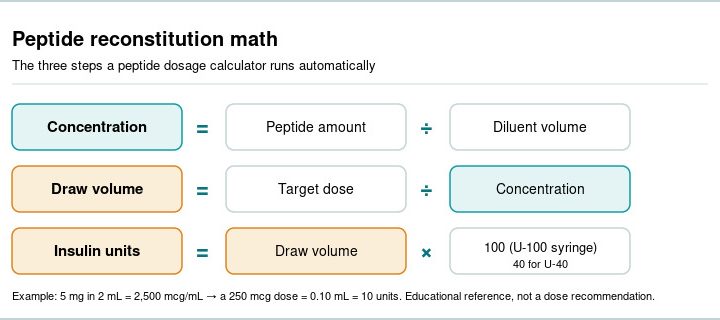
All three tools share the same arithmetic. Concentration is the amount of peptide divided by the volume of diluent, and everything else follows from it.
Reconstitute a vial turns a lyophilized vial into a dose (modes A, B and C). Units ↔ dose converts between insulin-syringe marks and a dose at a known concentration — remember a unit is a volume mark, so the milligrams always depend on the concentration. Dilute solves C₁V₁ = C₂V₂ for an already-mixed solution; you can only dilute to a lower concentration.
Reconstitution & handling notes
Diluent. Multi-dose vials are usually reconstituted with bacteriostatic water (sterile water with ~0.9% benzyl alcohol); preservative-free sterile water is generally single-use. Follow the product information.
Technique. Add diluent slowly down the vial wall and let the powder dissolve — do not shake. Disinfect the stopper before each entry, use a fresh sterile needle and syringe, and inspect that the solution is clear.
Storage. Reconstituted peptides are generally refrigerated (~2–8 °C), protected from light, and used within the window stated by the manufacturer or pharmacy. These are general notes, not instructions for any specific compound or dose.
Glossary
- Reconstitution
- Dissolving freeze-dried peptide in a measured volume of liquid to make a known concentration.
- Concentration
- Amount of peptide per millilitre, e.g. 2,500 mcg/mL.
- Insulin unit
- A mark on the syringe barrel (a volume), not a unit of peptide. U-100: 100 units = 1 mL.
- mcg vs mg
- 1 mg = 1,000 mcg. Mixing these up is the most common dosing error.
- Dilution (C₁V₁=C₂V₂)
- Lowering a solution’s concentration by adding diluent; the amount of peptide stays the same.
- Beyond-use date
- The date after which a reconstituted vial should no longer be used.
- These tools perform dilution arithmetic only. They are for educational and professional reference, do not constitute medical advice, and do not recommend, endorse or imply any dose, frequency, schedule, indication or compound. Dose and suitability must be set by a qualified, licensed healthcare professional or a validated research protocol.
- Regulatory status (2026) is unsettled. Many listed compounds — BPC-157, TB-500, CJC-1295, ipamorelin, AOD-9604, sermorelin, GHK-Cu — are not FDA-approved for human use and have no USP/NF monograph; in April 2026 the FDA removed BPC-157, TB-500 and CJC-1295 from Category 2 of the 503A bulks list without adding them to the permitted list (a PCAC review was set for July 2026). HCG is an approved prescription medicine. Legality varies by country and "research-use-only" products are not pharmaceutical-grade.
- Reconstitution and administration require aseptic technique and training. Verify every value against the actual product label and your institution’s protocols. No warranty is made; the authors accept no liability. If in doubt, consult a licensed clinician or pharmacist.
This peptide dosage calculator does three jobs: it turns a lyophilized vial into an exact, drawable dose, it converts between insulin-syringe units and a dose, and it dilutes an existing solution using C1V1 = C2V2. Enter the amount of peptide in the vial, the volume of bacteriostatic water you add, and your target dose, and it returns the concentration, the volume to draw, the mark to fill on an insulin syringe, and the number of doses per vial. Below, this peptide dosage calculator guide explains the reconstitution maths it uses, how much diluent to add, how to convert between micrograms, milligrams and insulin units, and how to dilute a solution that is too strong.
It is written as an educational reference for clinicians and informed patients not medical advice, a prescription, or an endorsement of any compound. Always follow your prescriber or pharmacist and confirm every figure against your product label before drawing or administering anything.
How the peptide dosage calculator works
Reconstitution simply means dissolving a freeze-dried (lyophilized) peptide in a sterile liquid so it can be measured and injected. Every output of the peptide dosage calculator follows from one value — concentration — which is the amount of peptide divided by the volume of diluent you add.
The reconstitution formula
The calculator chains three short steps:
- Concentration = peptide amount ÷ diluent volume.
- Volume to draw = target dose ÷ concentration.
- Syringe units = volume to draw × the syringe calibration (100 for a U-100 syringe, 40 for U-40).
- Doses per vial = peptide amount ÷ target dose.
For example, dissolving a 5 mg vial in 2 mL of bacteriostatic water gives 2,500 mcg/mL. A 250 mcg dose is then 0.1 mL, which reads as 10 units on a U-100 insulin syringe, and the vial holds 20 such doses. These numbers are illustrative arithmetic, not a recommended dose.
Reading insulin-syringe units
A “unit” is a mark on the insulin-syringe barrel — a measure of volume, not of peptide. On a U-100 syringe, 100 units equal 1 mL, so one unit is 0.01 mL; a U-40 syringe holds 40 units per millilitre. Because the marks are fixed, the cleanest way to get a tidy dose is to choose a diluent volume that makes your dose land on a whole number of units, which the reverse mode of the calculator does for you.
How much bacteriostatic water to add
There is no single “correct” volume of diluent — it only sets the concentration, and therefore how many units each dose occupies on the syringe. Most multi-dose vials are reconstituted with roughly 1–5 mL: less diluent gives a higher concentration and a smaller, harder-to-measure draw, while more diluent spreads each dose over more units. Add the water slowly down the inside wall of the vial and let the powder dissolve on its own; never aim the stream at the pellet and never shake, because agitation degrades fragile peptides. If you want to work backwards from a target, our bacteriostatic water calculator solves for the exact volume to add.
Bacteriostatic water vs sterile water
Bacteriostatic water is sterile water containing about 0.9% benzyl alcohol, a preservative that lets a vial be re-entered for a limited period (often up to 28 days once punctured, per the product label). Preservative-free sterile water has no such protection and is intended for single use. Benzyl alcohol should be avoided in neonates. You can read the approved labelling for both diluents on the U.S. National Library of Medicine’s DailyMed database.
Is bacteriostatic water the same as reconstitution solution?
“Reconstitution solution” is a marketing label rather than a standardised product; in practice it is usually bacteriostatic water or sterile water. Because the preservative content determines whether a vial can be reused and for how long, always read the actual ingredients on the label rather than relying on the product name.
Converting peptide doses: mcg, mg and insulin units
Two conversions cause most dosing errors. The first is between milligrams and micrograms (1 mg = 1,000 mcg); the second is between a dose in micrograms and the units shown on an insulin syringe. Units alone never tell you the milligrams — you also need the concentration. The general rule the peptide dosage calculator applies is: dose delivered (mcg) = (units ÷ 100) × concentration (mcg/mL) on a U-100 syringe, and its units-to-dose mode performs this conversion in either direction. The table below shows it at an example concentration of 2,500 mcg/mL; for compounded GLP-1 peptides, see our semaglutide dosage calculator.
| Syringe units | Volume (mL) | Dose delivered |
|---|---|---|
| 5 units | 0.05 mL | 125 mcg |
| 10 units | 0.10 mL | 250 mcg |
| 15 units | 0.15 mL | 375 mcg |
| 20 units | 0.20 mL | 500 mcg |
| 25 units | 0.25 mL | 625 mcg |
| 40 units | 0.40 mL | 1,000 mcg (1 mg) |
| 50 units | 0.50 mL | 1,250 mcg |
To use a different concentration, keep the volume column (units ÷ 100) and multiply by your own mcg/mL. Convert the result to milligrams by dividing by 1,000.
How to dilute a peptide solution (C1V1 = C2V2)
If a reconstituted solution is more concentrated than you need, you can dilute it instead of mixing a fresh vial. Dilution follows the standard relationship C1V1 = C2V2, where C1 and V1 are the concentration and volume of the stock you start with and C2 and V2 are the concentration and volume you want. Rearranged, the volume of stock to take is V1 = (C2 × V2) ÷ C1, and the diluent to add is V2 − V1. You can only dilute to a lower concentration — adding diluent never makes a solution stronger. The dilution mode of the calculator solves this and shows the stock-versus-diluent split.
Worked dilution example
Suppose your stock is 5,000 mcg/mL and you want 1,000 mcg/mL in a final volume of 2 mL. Then V1 = (1,000 × 2) ÷ 5,000 = 0.4 mL of stock, topped up with 1.6 mL of bacteriostatic water. The dilution factor is C1 ÷ C2 = 5×. Prepare every dilution with sterile technique and re-label the new concentration and beyond-use date.
Reconstitution examples by peptide
The table gives worked examples of concentration for common research peptides using typical vial sizes. They are arithmetic illustrations only — vial sizes vary by supplier, so always verify against your label, and note the regulatory status discussed further down.
| Peptide | Example vial | Diluent added | Resulting concentration |
|---|---|---|---|
| CJC-1295 / Ipamorelin | 5 mg | 2 mL | 2,500 mcg/mL |
| BPC-157 | 5 mg | 2 mL | 2,500 mcg/mL |
| TB-500 | 5 mg | 2 mL | 2,500 mcg/mL |
| GHK-Cu | 50 mg | 5 mL | 10,000 mcg/mL (10 mg/mL) |
| Sermorelin | 5 mg | 2 mL | 2,500 mcg/mL |
| HCG (prescription) | 5,000 IU | 5 mL | 1,000 IU/mL |
CJC-1295 / Ipamorelin reconstitution
This blend is commonly supplied as a single 5 mg vial. Adding 2 mL of bacteriostatic water yields 2,500 mcg/mL of the combined peptides; halving the diluent to 1 mL doubles that to 5,000 mcg/mL. The split between the two peptides depends on how the vial was filled, so follow the compounding documentation for the per-component amounts.
BPC-157 reconstitution
A 5 mg BPC-157 vial in 2 mL gives 2,500 mcg/mL; a 10 mg vial in 2 mL gives 5,000 mcg/mL. For exact, repeatable measuring, pick the diluent volume that places your prescribed dose on a round unit mark. For per-compound figures, see our BPC-157 dosage calculator. BPC-157 is investigational and is not approved for human use.
Safe handling, storage and beyond-use dates
Reconstitution and injection are sterile procedures. Disinfect the stopper before every entry, use a fresh sterile needle and syringe each time, and inspect the solution — it should be clear and free of particles. The U.S. Centers for Disease Control and Prevention summarises these steps in its safe injection practices guidance, and beyond-use dating for compounded sterile preparations is set out in USP General Chapter <797>.
Do reconstituted peptides need to be refrigerated?
Generally yes. Once reconstituted, peptides are usually stored at about 2–8 °C, protected from light, while unopened lyophilized powder is typically kept frozen. Confirm the exact conditions on your product or pharmacy documentation.
How long do reconstituted peptides last?
It varies by compound, formulation and storage. Many compounding pharmacies assign a refrigerated beyond-use date measured in weeks, but stability is product-specific — use the discard date provided with your vial rather than a general figure, and never use a solution that looks cloudy or discoloured.
Frequently asked questions
How do I reconstitute a peptide?
Inject the chosen volume of bacteriostatic water slowly down the inside wall of the vial, then let the powder dissolve without shaking. Concentration equals the peptide amount divided by the diluent volume; a peptide dosage calculator converts that into the volume to draw and the units to fill on an insulin syringe.
How much bacteriostatic water should I add to a 5 mg vial?
Any volume works because it only sets the concentration. Adding 1 mL gives 5,000 mcg/mL and 2 mL gives 2,500 mcg/mL; more diluent makes each dose easier to measure on the syringe. Always match the figure on your product label and your prescriber’s instructions.
How many milligrams is 40 units on an insulin syringe?
Units measure volume, not milligrams. On a U-100 syringe, 40 units is 0.4 mL, and the milligrams depend on the concentration. At 2,500 mcg/mL, 0.4 mL delivers 1,000 mcg (1 mg). Recalculate for your own concentration.
What is the C1V1 = C2V2 dilution formula?
C1V1 = C2V2 links the concentration and volume of a stock solution to the concentration and volume after dilution. To find how much stock to use, rearrange it to V1 = (C2 × V2) ÷ C1; the diluent to add is V2 − V1. You can only dilute to a lower concentration.
How do I dilute a peptide solution that is too concentrated?
Choose the final concentration (C2) and final volume (V2) you want, take V1 = (C2 × V2) ÷ C1 of your stock, and top up with diluent to V2. For example, to turn 5,000 mcg/mL into 1,000 mcg/mL in 2 mL, take 0.4 mL of stock and add 1.6 mL of bacteriostatic water.
Is bacteriostatic water the same as sterile water?
No. Bacteriostatic water contains a benzyl-alcohol preservative that allows a multi-dose vial to be re-entered for a limited time, whereas sterile water has no preservative and is intended for single use.
Do reconstituted peptides need to be refrigerated?
Generally yes. After reconstitution, peptides are usually kept at about 2–8 °C and protected from light, and used within the window stated by the manufacturer or compounding pharmacy.
How many doses are in a peptide vial?
Divide the total peptide in the vial by your dose. A 5 mg (5,000 mcg) vial provides 20 doses of 250 mcg, regardless of how much diluent you add — the diluent changes only the volume per dose.
Are these peptides FDA-approved?
Most research peptides — including BPC-157, TB-500, CJC-1295, ipamorelin, AOD-9604, sermorelin and GHK-Cu — are not FDA-approved for human use and have no USP monograph, and their compounding status is unsettled. HCG is an approved prescription medicine. See the FDA list of bulk drug substances used in compounding under section 503A, and use any peptide only under a qualified clinician.
Regulatory note (2026). In April 2026 the FDA removed BPC-157, TB-500 and CJC-1295 from Category 2 of the 503A bulk-substances list but did not move them to the permitted Category 1 list, and a Pharmacy Compounding Advisory Committee review was scheduled for July 2026. These compounds remain in a regulatory grey zone, legality differs by country, and “research-use-only” products are not manufactured to pharmaceutical standards. Verify the current status before relying on it.